
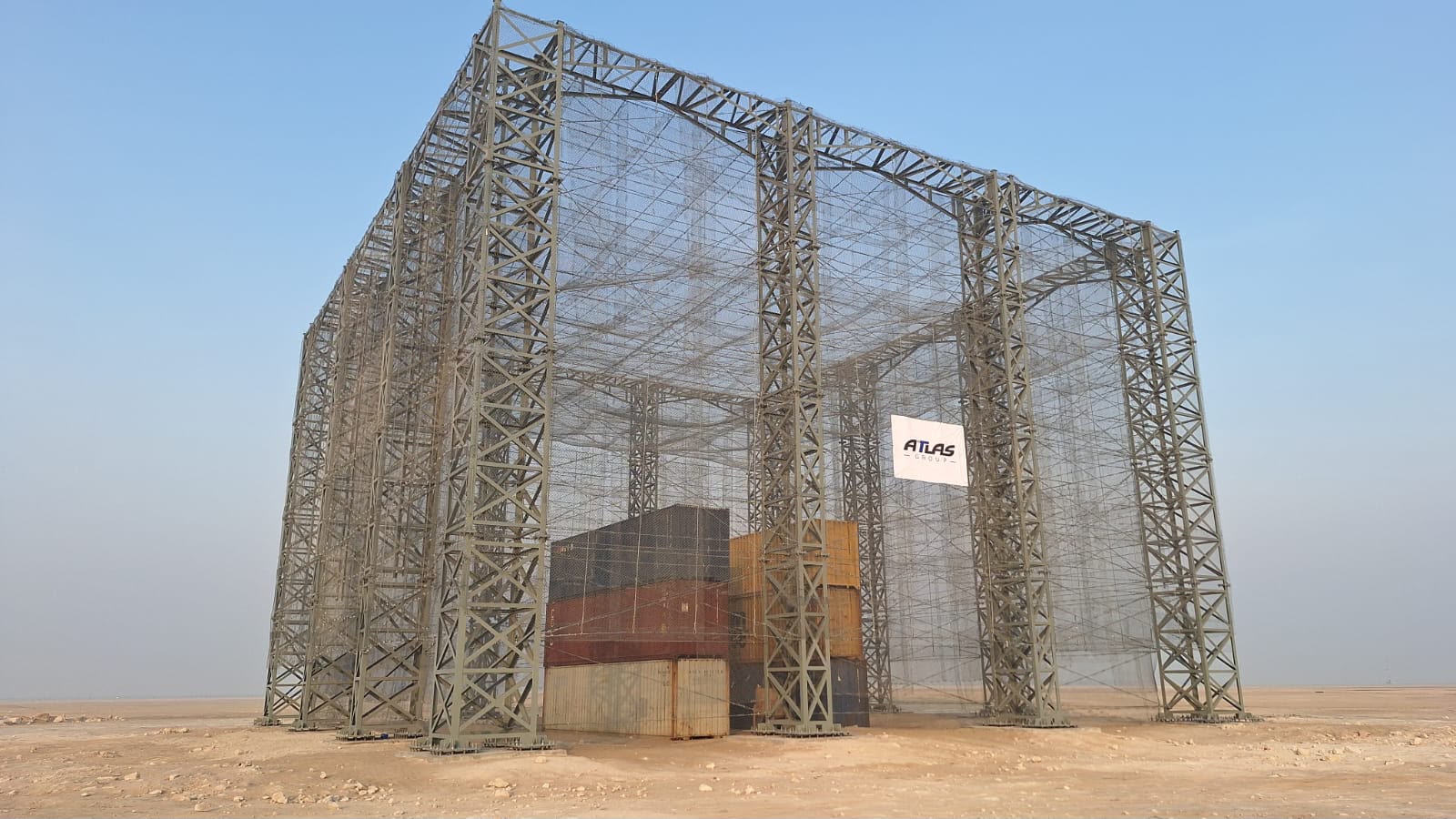
Aircraft arrestor systems were developed to manage a difficult engineering problem: how to slow a moving object over a limited distance without transferring excessive forces to the object or the surrounding structure. The answer is not simply a stronger net. It is a coordinated system of flexible materials, connections, supports, and—where appropriate—energy-absorbing equipment.
Today, some of those same engineering principles are relevant to physical netting used for unmanned aircraft systems (UAS). But the comparison has limits. A runway arrestor system is designed to engage an aircraft under defined conditions. Drone netting may be intended to contain routine flight operations, restrict access to a protected area, or intercept a particular aircraft under specified conditions. These are different applications, and they cannot be assigned the same performance expectations without appropriate engineering and evidence.
The distinction matters because drone protection netting is an emerging application in a rapidly changing counter-UAS field. Aircraft designs, operating methods, and threat profiles continue to evolve. A responsible specification starts with the intended use and the best available information—not a universal claim that one mesh or cord construction can stop every drone.
The engineering legacy of aircraft arrestor systems
Aircraft arresting equipment has long used combinations of engaging elements, supports, and energy-management mechanisms to bring moving aircraft to a stop. Naval aviation developed barriers and barricades for emergency recovery, while land-based runway arresting systems use specialized equipment to manage aircraft overrun events.
The details vary by system, but a consistent lesson emerges: the engaging net or cable is only one component. Loads must be transferred through the connections and supports to equipment designed for the expected event. The amount of available stopping distance and the behavior of the complete assembly are central to the design.
Vehicle security barriers offer a related lesson. Crash-test classifications, including those established under ASTM F2656, describe the performance of tested barrier assemblies under specified conditions. A material’s breaking strength, by itself, is not a crash rating. Those vehicle classifications do not certify drone netting, but the distinction between material properties and demonstrated system performance remains useful.
Four principles that carry over—and where they do not
1. Define the event before selecting the net
The expected aircraft, its geometry, mass, speed, and potential impact direction influence the requirements. For flight containment, the objective may be to keep an aircraft within a defined operating area. For a protective barrier, the objective may be to reduce the likelihood of an aircraft passing into a particular space. For a catch-net application, allowable deflection and impact-energy management may be especially important.
These objectives should not be treated as interchangeable. Nor does preventing the aircraft from passing through a net necessarily establish protection against an attached payload, fragments, or other secondary hazards.
2. Evaluate the complete load path
Mesh, cord construction, borders, attachment hardware, support spacing, anchors, and the supporting structure all affect installed performance. A strong cord does not compensate for an inadequate connection or an unsuitable mounting surface. Outdoor applications also require attention to wind, weather exposure, and long-term material behavior.
3. Account for movement and clearance
Flexible netting can deflect under load. Where impact containment is an objective, the design must consider how far the net may move and what lies behind it. More deflection is not automatically better: the available clearance, expected loads, and intended protection objective determine what is acceptable.
4. Plan for inspection and maintenance
Inspection access, replaceable components where practical, and clear maintenance responsibilities can improve long-term usability. After an impact, the net and its attachments may require inspection, repair, or replacement. The extent of work depends on the event and the actual system condition; field repair should not be assumed for every installation.
Drone netting is developing alongside a changing threat
Counter-UAS technology is not a settled category. Small drones differ widely in dimensions, construction, speed, control method, and intended use. New aircraft configurations and operating techniques can change what a site needs to protect against. Standards and evaluation practices are also developing across the broader counter-UAS field.
This makes fixed, universal claims especially risky. A mesh opening appropriate for one aircraft may not be appropriate for a smaller or differently shaped one. A cord selected for a low-energy containment application may be unsuitable for a higher-energy impact. A configuration assessed against one set of conditions should not automatically be described as effective against another.
Physical netting has an important characteristic: unlike radio-frequency countermeasures, it does not depend on disrupting a control link. That can make it a useful passive layer even when a drone uses autonomous navigation or a non-radio control method. However, a physical barrier is not a complete counter-UAS solution. Its effectiveness remains conditional on the aircraft, the installation, and the event. Site security may require multiple complementary measures.
There are standards addressing aspects of unmanned-aircraft impacts and counter-UAS systems, but vehicle-barrier crash ratings such as ASTM F2656 are not drone-netting certifications. Customers should ask what a quoted strength value or test result actually measures, whether it applies to a material or a complete assembly, and how closely the test conditions match their intended application.
Matching netting to the application
Rather than treating broad labels such as “consumer drone,” “FPV drone,” or “military UAV” as fixed engineering specifications, Leon De Oro USA approaches drone netting selection through the project requirements.
A useful starting point includes:
- Aircraft characteristics: the smallest relevant aircraft, anticipated size range, mass, geometry, and operating conditions.
- Purpose: keeping aircraft within a test area, restricting access to a defined space, or providing a passive protective layer against a specified threat.
- Mesh and cord: opening size, material, construction, and diameter considered together rather than as independent guarantees of performance.
- Installation: overall dimensions, span, available clearance, attachment locations, support structure, and environmental exposure.
- Operational needs: permanent versus relocatable installations, inspection access, maintenance, availability, and project schedule.
- Evidence: applicable material documentation, engineering review, and project-relevant testing where available or required.
These factors can lead to different netting solutions even when two projects involve similar aircraft. For example, an indoor research enclosure and an outdoor perimeter barrier may require different structural and environmental considerations.
For an overview of application options, visit our Drone, UAV & UAS Netting page. Published categories and illustrative configurations should be treated as selection guidance, not as universal impact ratings.
Material selection without unnecessary complexity
Custom netting specifications involve tradeoffs among strength, weight, mesh geometry, environmental durability, availability, and cost. The appropriate choice depends on the intended application and the supporting structure—not simply on selecting the strongest available fiber.
Leon De Oro USA works with customers on custom netting selection and manufacturing. Depending on project requirements, this may involve evaluating alternative mesh openings, cord constructions, materials, and dimensions. Specialty materials should be considered where the application justifies them, while practical manufacturing and lead-time considerations remain part of the decision.
No material designation or cord breaking-strength figure should be interpreted, on its own, as a promise that an installed net will arrest a particular aircraft.
Designing for an application that may change
Because drone technology and operating conditions are evolving, a netting specification should document its assumptions. Which aircraft were considered? What impact or containment objective was used? What conditions would require the design to be reviewed again?
For some projects, modular construction or accessible attachment points may help with inspection, maintenance, or future changes. Whether those features are appropriate or available should be determined during project development. A change in the anticipated aircraft, threat profile, or site configuration may require a new engineering assessment rather than a simple material substitution.
This is an important part of responsible product development in an emerging field: distinguish what is established, what has been evaluated for a specific application, and what still needs validation.
Where Leon De Oro USA fits
Leon De Oro USA supports customers with custom netting selection, manufacturing, and project-specific engineering coordination. Depending on scope, projects may also involve structural engineering, installation support, or coordination with qualified partners. Responsibilities, deliverables, and any required performance verification should be defined for each project.
Our role is to help translate an operational need into a practical netting specification, with attention to material properties, geometry, installation conditions, and the limitations of available evidence. We do not treat historical arrestor-system experience or general material strength as proof of performance against every drone.
The most useful lesson from arrestor engineering is not that one net can stop anything. It is that performance depends on defining the event and evaluating the complete system. That is a sound starting point for drone netting, especially while the technology and its applications continue to change.
Discuss your project with Leon De Oro USA. Call 833-888-2634 or request information to review your application and specification needs.
