
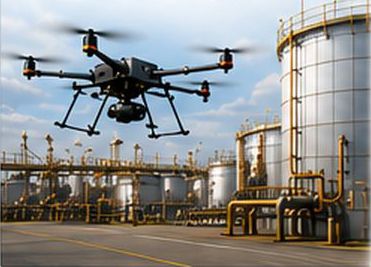
A net does not depend on how a drone is controlled. Detection systems must identify a target, while RF-based countermeasures generally depend on exploitable communications or navigation signals. Fiber-optic-controlled first-person view (FPV) systems can remove the radio-control link entirely. Properly specified physical netting offers a complementary, passive protective layer, provided the installed system is designed for the anticipated aircraft and impact conditions.
Start with the threat and the mission
The first conversation is about what you are protecting and what you are protecting it from.
Three questions help establish the initial requirements:
- What is the smallest drone you have to stop?
- Is the job to keep drones out, to contain them inside a boundary, or to catch one that fails in flight?
- And does the environment call for a permanent installation, or something a crew can deploy and relocate?
Answer those and the spec starts to take shape. Without these inputs, specifications risk being based on incomplete assumptions.
Match the drone class to mesh and cord
Mesh opening helps determine whether an aircraft can pass through the net, making it an important starting point for the specification.
DYNORO™ drone nets break down by drone class:
- Smaller UAS, including aircraft within DoD Groups 1 and 2, encompass a broad range of sizes, geometries, and operating characteristics. Mesh opening and cord construction should be selected based on the specific aircraft and expected impact conditions rather than group classification alone.
- Available netting configurations may include different cord diameters and mesh openings, with final selection based on aircraft geometry, anticipated impact loading, span, and installation requirements.
The smallest aircraft may determine the maximum acceptable mesh opening, while the most demanding anticipated impact can determine strength and structural requirements. Both must be considered when specifying the system. A 100 mm mesh is lighter and takes less wind, but a 100 mm mesh may not reliably contain smaller FPV-class aircraft. If smaller FPV-class aircraft are part of the anticipated threat, mesh openings must be selected accordingly. Larger aircraft may impose additional strength and structural requirements, even when their dimensions exceed the mesh opening.
Operational requirements shape the final specification.
Two buyers can need the same drone class and still land on different nets. What the site is, and how it operates, decides almost everything past the mesh.
Military and defense
Force protection drives this work. The applications run from counter-UAS perimeter barriers around bases, depots, and command facilities to overhead drape nets. Shrouds intended to provide a physical protective layer for parked vehicles and staging areas against specified FPV and drone-dropped threats.
Two demands set defense apart. The first is deployability. A forward operating base needs systems a crew can stand up fast and move, which is a different build than a permanent perimeter at a fixed installation. The second is containment that works in both directions. Training ranges and drone test facilities have to hold flight inside a boundary, not just keep intruders out. Defense R&D enclosures add a security layer on top, since the systems under test are sensitive in their own right.
University and research
Here the emphasis often shifts from intrusion protection to flight containment and asset protection. University programs need flight cages sized for instruction, sponsored research, and student competitions. Autonomy and algorithm work, including swarming and AI navigation, needs an enclosed space where a unit that loses its way stays put instead of leaving the building.
Prototype validation may require catch netting, where controlled deflection and impact-energy management are important design considerations. For prototype catch applications, controlled deflection can help reduce peak deceleration and potential damage. Environmental and marine groups push the material harder, running operations over water and pulling equipment back out of it. National and aerospace labs run sustained programs across several drone classes at once, which calls for large-format containment built to one coherent spec rather than a patchwork of smaller nets.
Industrial
The common thread is a high-value site facing a real intrusion risk. Critical infrastructure treats airspace intrusion as a security problem in itself: substations, telecom sites, water treatment plants, and data centers. Energy and petrochemical operations raise the stakes again, since an unauthorized overflight at a refinery, a nuclear facility, or an LNG terminal carries consequences that sit inside a much larger safety case.
Corporate campuses and manufacturers use perimeter and overhead netting to protect proprietary operations and research from surveillance. Logistics and warehousing sites testing drone-based inventory or delivery need containment around their own flight operations. Correctional facilities have to stop contraband delivery and surveillance over a wall, outdoors and year-round. Stadiums and event venues need temporary physical drone protection or containment that goes up and comes down on an event schedule.
Mounting, span, and how it deploys
Mesh and cord set the fabric. Mounting, span, and deployment set the engineering.
A perimeter on an existing fence line is a different build than a free-standing flight cage at a research facility, and both differ from a rapid-deploy system a crew has to relocate. Span drives the cord and the support spacing. It also sets the load on every anchor point. The structure you attach to decides what is even possible, and a substation fence or an older roof may not carry what a large enclosure puts on it.
Wind loading is a critical consideration for outdoor installations. Mesh openness, cord diameter, net area, and mounting geometry all influence the forces transferred to the supporting structure.
Material
DYNORO™ drone netting solutions include knotless polypropylene constructions, selected according to application requirements.
Knotless construction can provide consistent mesh geometry and favorable weight characteristics. Polypropylene also offers low moisture absorption, making it useful in many wet-environment applications. Long-term suitability should account for UV exposure, installation tension, environmental conditions, and the selected material formulation.
What a real spec needs from you
The spec comes together fastest when you can describe the situation in operational terms. Before the first call, it helps to know:
- The smallest drone class in your threat picture
- Whether the net keeps drones out, contains them, or catches them
- The environment and the rough dimensions of the area
- What the system mounts to, or whether it has to deploy and relocate
Defense and federal work adds documentation to that list: material data, test results, country-of-origin records, and fire ratings where the spec calls for them. Contact us to verify available documentation appropriate for your project specification.
Where León de Oro fits
Leon De Oro USA supports customers through netting selection, custom manufacturing, and project-specific engineering coordination. Depending on the application and project scope, additional services may include structural engineering, installation support, and coordination with qualified installation partners.
We help customers develop project-appropriate netting specifications and manufacture custom solutions, including nonstandard dimensions and mesh configurations. Depending on project requirements, we can also coordinate engineering and installation considerations with customers and qualified project partners. Our value begins with getting the specification right and continues through manufacturing and project support.
Common specification mistakes to avoid
A common specification mistake is selecting mesh based on a single aircraft rather than the full range of anticipated threats. Smaller drones may pass through openings selected for larger aircraft, while higher-energy impacts can impose additional demands on cord strength, attachment methods, and supporting structures.
The other recurring mistake is using a perimeter spec for what is really a catch-net job, where give and fall energy matter more than opening size. Both come from skipping the questions at the top. Describe the threat, the mission, and the site to our team. These inputs establish the foundation for an appropriate netting specification.
