
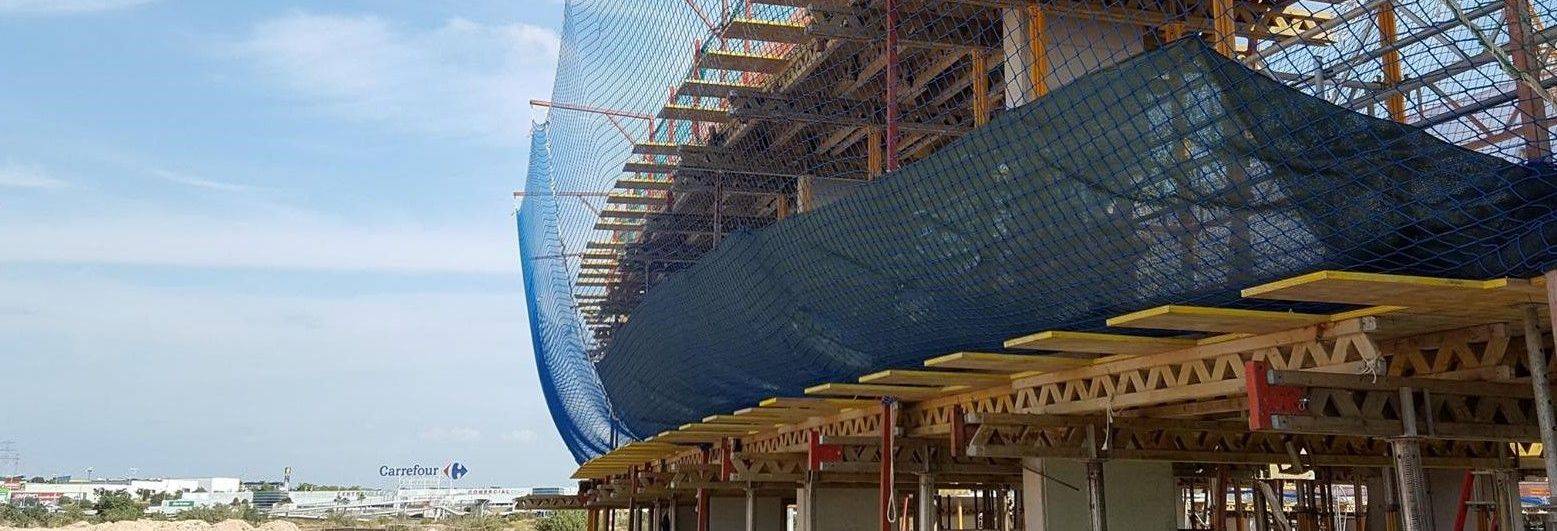
The netting scope hides in plain sight. Safety netting can appear as a minor line item in the fall protection plan, yet become a critical scheduling consideration. It usually gets there the same way: anchor points that clash with another trade’s work, an order that went in too late, or a net that came down and went back up because the sequence never accounted for it.
You already coordinate steel, MEP, formwork, facade, and crane picks against each other. The net belongs in that coordination, not off to the side as a safety line item. Here are the common coordination challenges and how to address them before installation.
The failure modes you’ll recognize
Anchor clashes. Nets need attachment points with real capacity, and those points want the same steel connections, embeds, and hanger locations everyone else is claiming. Draw the anchor layout without running it against the steel connection design and the MEP model, and the clash surfaces in the field. The result can be additional RFIs, revised drawings, and avoidable schedule impacts.
Late buyout, long lead. Custom-engineered netting may require additional time for design review, approvals, and fabrication. A layout revision restarts the clock on the submittal-and-fabrication cycle. Miss the required-on-job (ROJ) date and your crew reaches the elevation with no net in place. The resulting delay may prevent work from proceeding safely and in compliance with project requirements.
Sequence conflicts. Netting installation must be sequenced alongside steel erection and subsequent trade activities.
Re-hangs. When netting must be relocated as construction progresses or to accommodate other trades, each move can introduce additional labor, scheduling requirements, and potential damage.
Trade damage. Hot work, rigging, and dropped material tear nets. Damage to safety netting must be addressed promptly because it can compromise the intended protection. Damaged netting may require affected work areas to remain inactive until the required protection is restored.
The cost rarely posts as one number. It spreads across change orders for field rework, extended general conditions when the sequence slips, standby, and re-hang labor. That’s how a footnote moves the critical path.
Pull the supplier forward, into preconstruction
Get the netting supplier into the coordination before the trades around the net commit their anchor locations. Once the steel connections and MEP routing are set, the net works around them, and available attachment locations may become constrained. Bring the supplier in during preconstruction and the anchor layout gets coordinated with the other systems instead of clashing with them in the model or the field.
León de Oro manufactures and supplies the netting system; installation is performed by the contractor or designated specialty installer. We work with project teams to understand the structure, elevations, and construction sequence as applicable to the project scope. Based on those requirements, we provide relevant product information and available technical documentation to support the team’s coordination and submittal process.
Who Installs the Netting, and Where Coordination Matters
Installation is performed by the contractor or designated specialty installer, with León de Oro providing applicable product information and technical support. Structural attachment design, installation methods, and site-specific safety compliance remain the responsibility of the appropriate project professionals.
Successful installation depends on coordinating netting requirements with the surrounding construction activities.
- Steel erection. Where netting attaches to structural steel, attachment locations must be coordinated with erection activities.
- MEP rough-in. Hangers, sleeves, and routing fight the net anchors for the same locations and capacity.
- Formwork and deck work. Horizontal nets under overhang and edge work have to live alongside the forming and the pour.
- Crane operations. Picks run through the airspace the net occupies, so a net in the wrong place blocks a lift.
- Facade and skin. Net removal should be coordinated with enclosure activities and the implementation of appropriate alternative protection.
You know all of these. The point is that the net sits at the intersection, so it can’t be bought out or scheduled as a standalone.
What to lock early
- Coordinate the anchor layout against steel and MEP before attachment points get committed.
- Treat a layout revision as a schedule event, not a resubmittal, and protect the ROJ.
- Give the net a defined install window and a removal milestone tied to enclosure or deck completion.
- Confirm installation responsibilities and required inspections by qualified or competent personnel, as applicable.
- Reengage the netting supplier when design or sequencing changes affect the netting system.
Plan Your Safety Netting Requirements Early
When coordinated early, safety netting remains aligned with the construction schedule: installed when required, coordinated with surrounding trades, and removed when the construction sequence and approved fall protection plan permit. When coordination is deferred until installation, the result can be additional RFIs, change orders, and avoidable work delays.
Contact León de Oro early in your project planning to discuss your safety netting requirements.
