
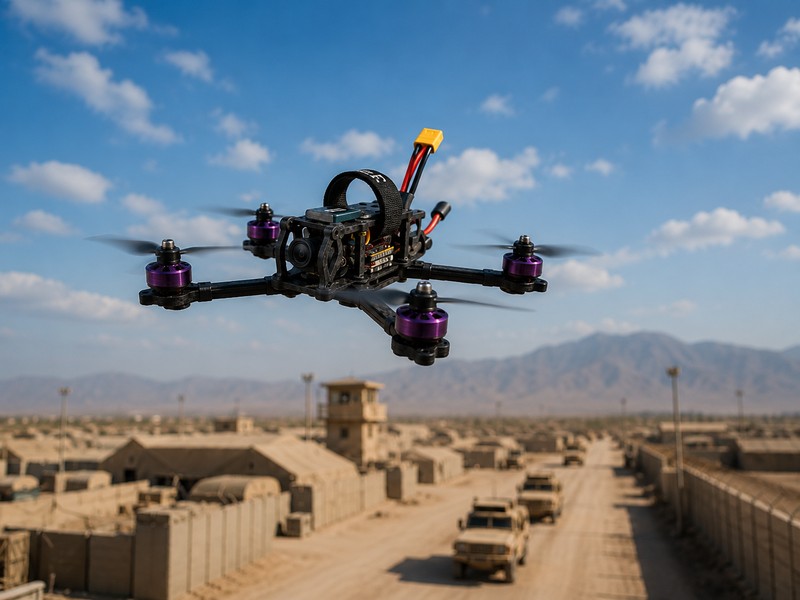
Most people looking for anti-drone netting already know they need a net. What they do not know yet is which one.
That question has more moving parts than it looks. Mesh opening, cord type, border construction, hardware interface, and how the system mounts all shift depending on what you are flying, what you are stopping, and where it goes. Get the structural design wrong, and wind loading on a large netted area can impose forces on anchors, cables, frames, and existing structures that were never designed to carry them.
This is the part we handle. León de Oro USA has spent four decades engineering and manufacturing netting systems, and we bring that to every drone project we quote.
We recommend the right configuration
We do not sell anti-drone netting as a one-size-fits-all product. Every quote starts with a conversation about your application.
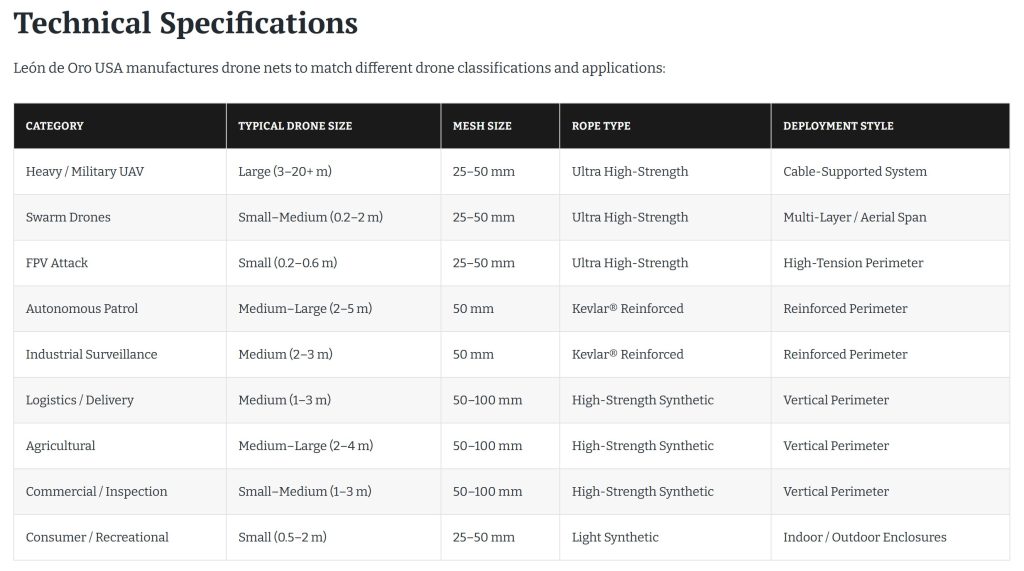
Tell us the drone class you expect, what you are protecting, your span and mounting conditions, and whether the system stays put or has to redeploy. From there we tell you what the net needs to be. A small FPV drone traveling at high speed and a much larger UAV moving more slowly can impose very different impact loads on a protection system. Aircraft size, mass, velocity, geometry, and anticipated impact conditions all influence mesh opening, cord construction, material selection, system deflection, support spacing, and attachment design. Our drone netting page lays out how those specifications break down across nine drone categories, from consumer aircraft to heavy military UAVs.
We design the system, not just the net
Netting is one piece of a working installation. The other pieces are the frame, the anchor points, the tensioning, and how all of it ties into what is already on your site.
We engineer support structures alongside the nets, which means we can work out the whole system with you rather than handing over a net and leaving the hard part to somebody else. That includes integration with existing security or facility infrastructure, cable-supported spans where a perimeter build will not reach, and installation planning your crew or specialty installer can actually work from.
We manufacture what we specify
We build to the specification required. Material options run from lightweight polypropylene for controlled training, research, and demonstration environments through polyester, nylon, Kevlar® and aramid constructions, as well as our own Dynoro® UHMWPE netting for projects that need high strength-to-weight performance and low stretch. If our standard formats do not fit, our team develops a tailored solution. That is a normal part of the work here, not an exception we make.
Built for the way you actually use it
Defense customers come to us for installation perimeters, forward operating base boundaries, range containment, and drape nets over parked vehicles and staging areas.
Research programs come to us for flight cages and catch nets sized to their aircraft, including configurations that support retrieval from water.
Industrial operators come to us for airspace control at substations, refineries, LNG terminals, data centers, correctional facilities, and event venues.
The applications are different, but the engineering approach is the same: understand the aircraft or threat, determine the anticipated loads and operating conditions, then design the netting and support system around the application.
Start with a conversation
Physical netting runs passively, needs no power or spectrum coordination, and works against autonomous and fiber-optic drones that may not be affected by conventional electronic countermeasures. It only does that well when the system is built for the application.
See the full breakdown on our UAV/UAS drone protection netting page, then contact us or call 833-888-2634 for an engineer-reviewed quote.
